

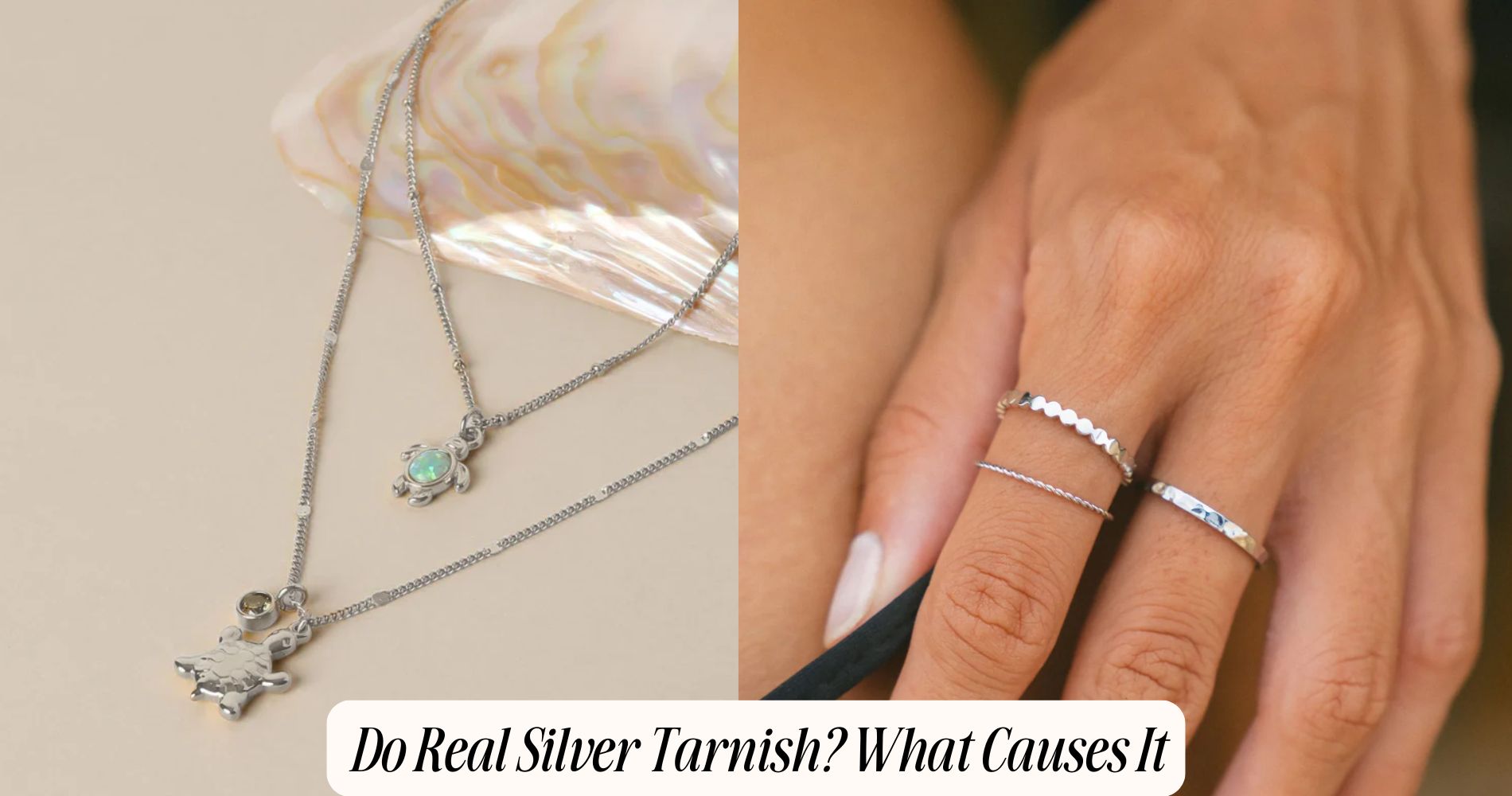
Do Real Silver Tarnish? What Causes It
Do real silver tarnish? Yes—real silver does tarnish. What you’re seeing is a thin layer of silver sulfide (Ag₂S) forming as silver reacts with airborne sulfur compounds like hydrogen sulfide (H₂S). This process is accelerated by humidity, pollutants, and skin thiols, and sterling silver (an Ag–Cu alloy) can tarnish faster due to copper’s reactivity. Heat and storage near rubber or wool increase sulfur exposure, while perspiration salts and cosmetics raise surface reactivity. Tarnish can appear yellow, brown, or blue-black and grows through diffusion over time. Proper storage, anti-tarnish sorbents, and gentle cleaning can reverse it—and choosing low-maintenance options like Waterproof Jewelry helps minimize everyday exposure. Next, you’ll find practical prevention and removal methods.
Why Real Silver Tarnishes Over Time
Although pure silver is relatively inert, it tarnishes because its surface reacts with sulfur-containing compounds in air, forming silver sulfide (Ag2S).
You observe tarnish formation as a thin, adherent film that progressively attenuates luster and shifts reflectance. In ambient conditions, trace hydrogen sulfide, organosulfur volatiles, and polluted atmospheres drive surface conversion.
Humidity accelerates ion transport, while chlorides, ozone, and particulate residues catalyze interfacial reactions. Silver oxidation is limited in dry air, but mixed atmospheres promote coupled pathways: sulfurization dominates, with minor oxide or chloride species at defect sites.
You also influence kinetics. Skin-contact introduces thiols and perspiration salts; storage near rubber, wool, or felt elevates sulfur exposure; low airflow traps reactive gases.
Microabrasions increase active sites, raising nucleation density and film growth rates over time.

The Chemistry Behind Silver Tarnish
While silver resists bulk oxidation, its surface chemistry is governed by sulfurization kinetics. You observe tarnish when adsorbed sulfur species react with metallic Ag to form silver sulfide (Ag2S), a semiconducting, black surface film.
The rate-limiting steps involve chemisorption, dissociation, and diffusion of sulfur-containing intermediates across grain boundaries and defects. Thermodynamically, Ag2S formation is favored over typical oxidation reactions because sulfide has a lower Gibbs free energy at ambient conditions.
You’ll also encounter minor contributions from Ag2O or AgO under specific potentials, but these oxides are thin, less stable, and often convert to Ag2S upon sulfur exposure.
Nucleation initiates at high-energy sites, then lateral growth proceeds via surface diffusion and film coalescence. Ultimately, tarnish thickness follows parabolic growth, indicating diffusion control through the developing Ag2S layer.
Everyday Factors That Accelerate Tarnishing
Because silver tarnish is driven by sulfur chemistry, everyday environments that elevate reduced sulfur exposure and surface reactivity accelerate it.
You’ll see faster sulfide film growth when humidity levels are high, because adsorbed water forms an electrolyte layer that speeds ion transport. Air pollutants—especially hydrogen sulfide, sulfur dioxide, and ozone—raise reaction kinetics and promote nonuniform patina.
Skin contact deposits chloride, fatty acids, and thiol residues that increase surface reactivity and microcrevice corrosion. Temperature changes drive condensation cycles, enhancing dissolution–precipitation of silver sulfide.
Reactive cleaning products can leave sulfur-bearing residues or abrasives that disrupt passivity and expose fresh metal.
Suboptimal storage conditions—porous papers, wool, rubber, or unventilated cases—off-gas reduced sulfur and trap moisture, sustaining localized reactions and accelerating tarnish propagation across artifacts.

How to Identify Tarnish vs. Damage or Dirt
Knowing what accelerates sulfide formation helps you read surfaces correctly: tarnish manifests as a coherent silver sulfide film, not loose soil or mechanical damage.
You’ll see uniform, adherent discoloration progressing from warm yellow to brown, violet, and blue-black—classic tarnish characteristics. Dirt appears particulate, uneven, and transferable to a swab.
Abrasion presents as linear scratches, bright metal peaks, and matte troughs without chromatic iridescence. Pitting, from corrosion or wear, yields cratered topography rather than a continuous film.
Use diagnostics: lightly rub with a microfiber; if residue transfers gray-black, it’s tarnish; if brown or oily, it’s soil.
Inspect under raking light; tarnish shows interference hues, while dirt casts granular shadows.
Apply controlled cleaning techniques: mild detergent for soil; sulfur-specific silver polish for sulfide films; avoid aggressive abrasives on intact patina.
Prevention Tips to Keep Silver Looking Bright
Even before tarnish initiates, control the sulfur load and moisture around your silver to suppress silver sulfide nucleation.
Use inert storage solutions: acid-free tissue, polyethylene zipper bags, or lacquered display cases with desiccant packs maintaining ≤30% RH.
Add activated charcoal or silver-safe sorbents to scavenge H2S, SO2, and thiol off-gassing from woods, foams, and rubber.
Avoid wool felt, newspaper, and sulfurized paper.
Wear cotton gloves to block chloride and sebaceous residues.
After handling, perform a preventive wipe with a non-abrasive, ammonia-free cloth; this counts as low-impact cleaning techniques without initiating metal loss.
Isolate silver from chlorinated pools, latex bands, and cosmetics.
Rotate display time to reduce pollutant dose.
For long-term protection, apply microcrystalline wax barriers on non-food-contact items, monitoring for haze and reapply only as needed.

Safe Methods to Remove Tarnish at Home and Professionally
While prevention reduces sulfur exposure, you’ll still need controlled removal methods that dissolve silver sulfide without stripping base metal or eroding detail.
At home, deploy low-risk natural remedies: immerse pieces in a hot sodium bicarbonate solution with aluminum foil to drive an electrochemical reduction of Ag2S to metallic silver; rinse and pat dry. For light films, use a non-abrasive silver polish with thiourea or proprietary reducing agents; follow dwell-time guidance and microfiber application.
Avoid toothpaste, baking-soda pastes, or abrasives that increase surface roughness.
For hallmarked antiques, gemstone-set pieces, or heavy tarnish, choose professional treatment. Bench jewelers use calibrated ultrasonic cleaning, low-abrasion rouge, and controlled thiourea baths. Conservation labs employ chelators, pH-buffered baths, and microcrystalline wax passivation.
Verify compatibility claims and SDS data for all commercial products.
Frequently Asked Questions
Is Tarnish Harmful to Health When Wearing Silver Jewelry?
No, tarnish generally isn’t harmful to health when you wear silver jewelry. You encounter silver sulfide surface films, not systemic toxins. Maintain jewelry safety: clean regularly, avoid abrasive removal, minimize sulfur exposure, and monitor for contact dermatitis or nickel sensitization.
Does Sterling vs. Fine Silver Tarnish at Different Rates?
Yes. Sterling tarnishes faster than fine silver. Due to sterling composition (92.5% Ag, copper alloy), sulfur-induced sulfide formation accelerates. Fine silver properties (99.9% Ag, minimal alloying) reduce reactivity, slower patination, less surface nucleation, thinner corrosion films under identical environmental exposures.
Can Rhodium or Gold Plating Prevent Silver Tarnish Entirely?
No, plating can’t prevent tarnish entirely. Rhodium’s inert barrier maximizes plating effectiveness and tarnish prevention until micro-abrasions expose silver. Gold plating slows sulfide formation, but porosity, wear, and pinholes permit diffusion pathways, necessitating thickness control, re-plating schedules, and proper storage.
Will Dishwasher Use Affect Silver Tarnish or Structural Integrity?
Yes—dishwasher effects accelerate tarnish and can compromise structural integrity. Chlorinated detergents, high pH, heat, and galvanic coupling induce sulfide formation, micro-pitting, and solder fatigue. Hand-wash, dry immediately, store anti-tarnish; prioritize silver maintenance with mild surfactants, low-abrasion media, and controlled humidity.
How Does Tarnish Impact the Resale or Appraisal Value of Silver?
Tarnish depresses resale by obscuring luster, hallmarks, and surface condition, reducing grade and liquidity. You can mitigate losses with professional tarnish removal and silver restoration, preserving patina selectively. Overpolishing alters mass, patination, and crispness, triggering further value deductions in appraisals.
Conclusion
You now know real silver does tarnish through sulfide formation, driven by sulfur-containing gases, humidity, and pollutants. You can distinguish tarnish from dirt via color, texture, and reaction tests, then choose targeted remediation: thiourea-based dips, micro-abrasive polishing, or electrolytic reduction. You’ll minimize recurrence by controlling exposure—airtight storage, anti-tarnish strips, desiccants, and regular gentle cleaning. Apply appropriate mechanical force, compatible chemistries, and protective lacquers or microcrystalline wax to preserve luster while limiting metal loss and surface micro-scratching.





%20forming%20as%20silver%20reacts%20with%20airborne%20sulfur%20compounds%20like%20hydrogen%20sulfide%20(H%E2%82%82S)...)
Leave a comment
This site is protected by hCaptcha and the hCaptcha Privacy Policy and Terms of Service apply.